قاف

The Mark & Its Methodology

The Seven Stations, read on the mark.

The Qaf mark — a single letter drawn as a diamond that climbs

Meaning of the mark

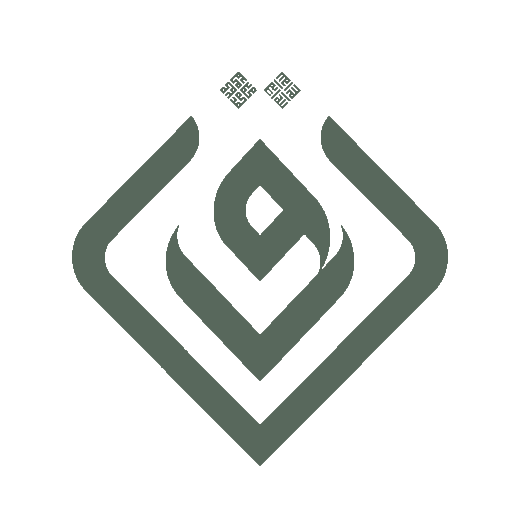
One Arabic letter — قاف — drawn as a diamond that climbs. Its two dots crown the summit; its curve opens at the base as an unfolding muṣḥaf. Nested at the centre is an ember, the qabas, and cradling it the qalb, the heart. The eye reads one form, but it carries several words at once, each of them a qāf. A monogram that is also a meditation.

Read it as a journey. The Qurʾān unfolds at the base — recitation to the left, the study of meaning to the right. From there the form ascends the mountain of the ʿulūm — fiqh to one side, ʿaqīda to the other — the whole climb a journeying to Allah and His Messenger ﷺ. The letter is not an ornament placed on a name; it is the pedagogy. Everything below sets out the climb the mark already draws.

The Seven Stations — curriculum spine

Each station names a qāf. Each is kindled by a Qurʾānic anchor, forms a maqām in the seeker, and instils an adab. Read here from the base upward.

  1. 1i

    Qurʾān

    قُرآنTalaqqī

    The recited Word received — the muṣḥaf at the base of the diamond. Everything above is a reading of what enters here.

    اقْرَأْ بِاسْمِ رَبِّكَ الَّذِي خَلَقَ

    Iqraʾ bismi Rabbika alladhī khalaq.

    “Recite in the name of your Lord who created.”

    Qurʾān, Sūrat al-ʿAlaq 96:1 — the first word to descend.
    Maqām
    Talaqqī — Reception. The posture of receiving a Word one did not author — listening before reasoning.
    Adab
    Presence and ṭahāra before the muṣḥaf. One recites before one interprets; the text is host, the student guest.

    At this station: The Qurʾān Beheld · The Loving Qurʾān · Kids · The Loving Qurʾān · All Abilities · The Loving Qurʾān · Sisters · The Loving Qurʾān · Brothers

  2. 2ii

    Qalb

    قَلبḤuḍūr al-qalb

    The vessel the Word lands in — the ontological centre of the mark. Adab before the sciences, even in the geometry.

    نَزَلَ بِهِ الرُّوحُ الْأَمِينُ · عَلَىٰ قَلْبِكَ لِتَكُونَ مِنَ الْمُنذِرِينَ

    Nazala bihi al-rūḥu al-amīn · ʿalā qalbika li-takūna min al-mundhirīn.

    “The Trustworthy Spirit brought it down upon your heart, that you might be among the warners.”

    Qurʾān, Sūrat al-Shuʿarāʾ 26:193–194 — revelation given an organ.
    Maqām
    Ḥuḍūr al-qalb — Presence of heart. The vessel made receptive, its veils thinned so the Word can settle.
    Adab
    Ikhlāṣ and taṣfiya — purifying intention so that knowledge lands in a heart cleared to hold it.

    At this station: The Heart of the Qurʾān · Loving the Prophet ﷺ · Chai Shai · Qalb Community

  3. 3iii

    Qabas

    قَبَسṬalab wa-himma

    The ember kindled in that heart — Mūsā moving toward the fire. The one warm light at the centre of the mark.

    إِنِّي آنَسْتُ نَارًا لَّعَلِّي آتِيكُم مِّنْهَا بِقَبَسٍ

    Innī ānastu nāran laʿallī ātīkum minhā bi-qabas.

    “I have perceived a fire; perhaps I can bring you a torch from it.”

    Qurʾān, Sūrat Ṭā Hā 20:10 — he sought a torch and found guidance.
    Maqām
    Ṭalab wa-himma — The seeking. The soul in motion toward light — moving to the fire rather than summoning it.
    Adab
    The humility of the ṭālib. What Mūsā found at the fire was hudā, not the ember he set out for — the seeker receives more than he asked.

    At this station: The Light Within

  4. 4iv

    Qiblah

    قِبلةTawajjuh

    The turn — fourth of seven, the hinge of the climb. The single act of the will between what is received and what is yielded.

    فَوَلِّ وَجْهَكَ شَطْرَ الْمَسْجِدِ الْحَرَامِ

    Fa-walli wajhaka shaṭra al-masjidi al-ḥarām.

    “So turn your face toward the Sacred Mosque.”

    Qurʾān, Sūrat al-Baqarah 2:144 — the whole face, one direction.
    Maqām
    Tawajjuh — Orientation. Once one sees by the light, the whole self is turned to a single point.
    Adab
    Niyya and wholeness — the ordering of a scattered self around one qiblah, so that learning has a destination and not only a source.

    At this station: The Fiqh of Worship

  5. 5v

    Qanāʿah

    قَناعةRiḍā

    The self made content — the nafs set in right relation to its provision, so knowledge is sought for its Giver, not the ego.

    قَدْ أَفْلَحَ مَنْ أَسْلَمَ، وَرُزِقَ كَفَافًا، وَقَنَّعَهُ اللَّهُ بِمَا آتَاهُ

    Qad aflaḥa man aslama, wa ruziqa kafāfan, wa qannaʿahu Allāhu bimā ātāh.

    “Successful is the one who submits, is granted sufficiency, and whom Allah makes content with what He has given him.”

    Narrated by ʿAbdullāh ibn ʿAmr ibn al-ʿĀṣ (raḍiyaLlāhu ʿanhumā). Ṣaḥīḥ Muslim, Kitāb al-Zakāh, no. 1054.
    Maqām
    Riḍā — Contentment. The nafs at rest with kafāf — sufficiency — its appetite quieted.
    Adab
    Adab with rizq. The verb qannaʿahu shares the q-n-ʿ root: qanāʿah is a station Allah bestows, not merely a discipline one achieves.

    At this station: Foundations of Faith

  6. 6vi

    Qalam

    قَلَمTablīgh

    The pen — the light now writes and transmits. Knowing becomes gift; what was received begins to overflow.

    الَّذِي عَلَّمَ بِالْقَلَمِ · عَلَّمَ الْإِنسَانَ مَا لَمْ يَعْلَمْ

    Alladhī ʿallama bi'l-qalam · ʿallama al-insāna mā lam yaʿlam.

    “Who taught by the pen — taught man that which he knew not.”

    Qurʾān, Sūrat al-ʿAlaq 96:4–5 — the same sūrah as the base, now turned outward.
    Maqām
    Tablīgh — Transmission. The one who received now conveys; ʿilm passes from a filled vessel to an empty one.
    Adab
    The pen as amāna — a trust transmitted without distortion. The teacher owes the chain the fidelity he was shown.

    At this station: Qalam · Word to the Wise · A ḥadīth · Word to the Wise · A verse

  7. 7vii

    Quwā

    قُوىTamkīn

    The faculties gathered, ordered, empowered — the summit. Each power finally in its right place: taʾdīb completed.

    يَا يَحْيَىٰ خُذِ الْكِتَابَ بِقُوَّةٍ

    Yā Yaḥyā khudh al-kitāba bi-quwwah.

    “O Yaḥyā, take the Book with strength.”

    Qurʾān, Sūrat Maryam 19:12 — the Book received at the base, now grasped with power.
    Maqām
    Tamkīn — Empowerment. Realized strength — a life that holds the Book with the fullness of its powers.
    Adab
    The end returns to the beginning, transformed. Word received becomes Word grasped — adab, in the al-Attas idiom, is every faculty put in its right place.

    At this station: Teen Girls Badminton · The Art of Manhood · The Art of Womanhood

The logic the ladder hides

القِبلة هي المِفصَل

Qiblah is the hinge

Fourth of seven, the structural centre. The lower three stations are receptive — the Word comes, lands, kindles. The qiblah is the one act of the will, the turning. The upper three are what a rightly-turned life yields: contentment, transmission, realized strength.

القَلب هو المركز

The heart is the centre

The ʿulūm climb the mountain, but the geometry is rooted in the qalb. The structural centre of the climb is the qiblah; the centre of being is the heart. Adab before the sciences — even in the composition of the mark.

النهاية بدايةٌ متحوِّلة

The end is the beginning, transformed

The climb opens with Qurʾān given and closes with Quwā — whose Qurʾānic register is precisely khudh al-kitāba bi-quwwah, the Book held with the fullness of one’s powers. You receive the Word at the base; at the summit you grasp it with an empowered soul.

The mark is the method. What the letter draws — Word received at the base, faculties empowered at the summit, the heart at its centre — the community walks, station by station.

Walk it with us — the weekly schedule →